
New article in npj Science of Food: From Metabolomics Dark Matter to Bioactivity
Pranav Gupta, Michael Gunning, Selena Ahmed, and Prof. Ilias Tagkopoulos published From metabolomics dark matter to bioactivity: a computational framework for prioritizing food-derived bioactive compounds in npj Science of Food on 8/25/2026.
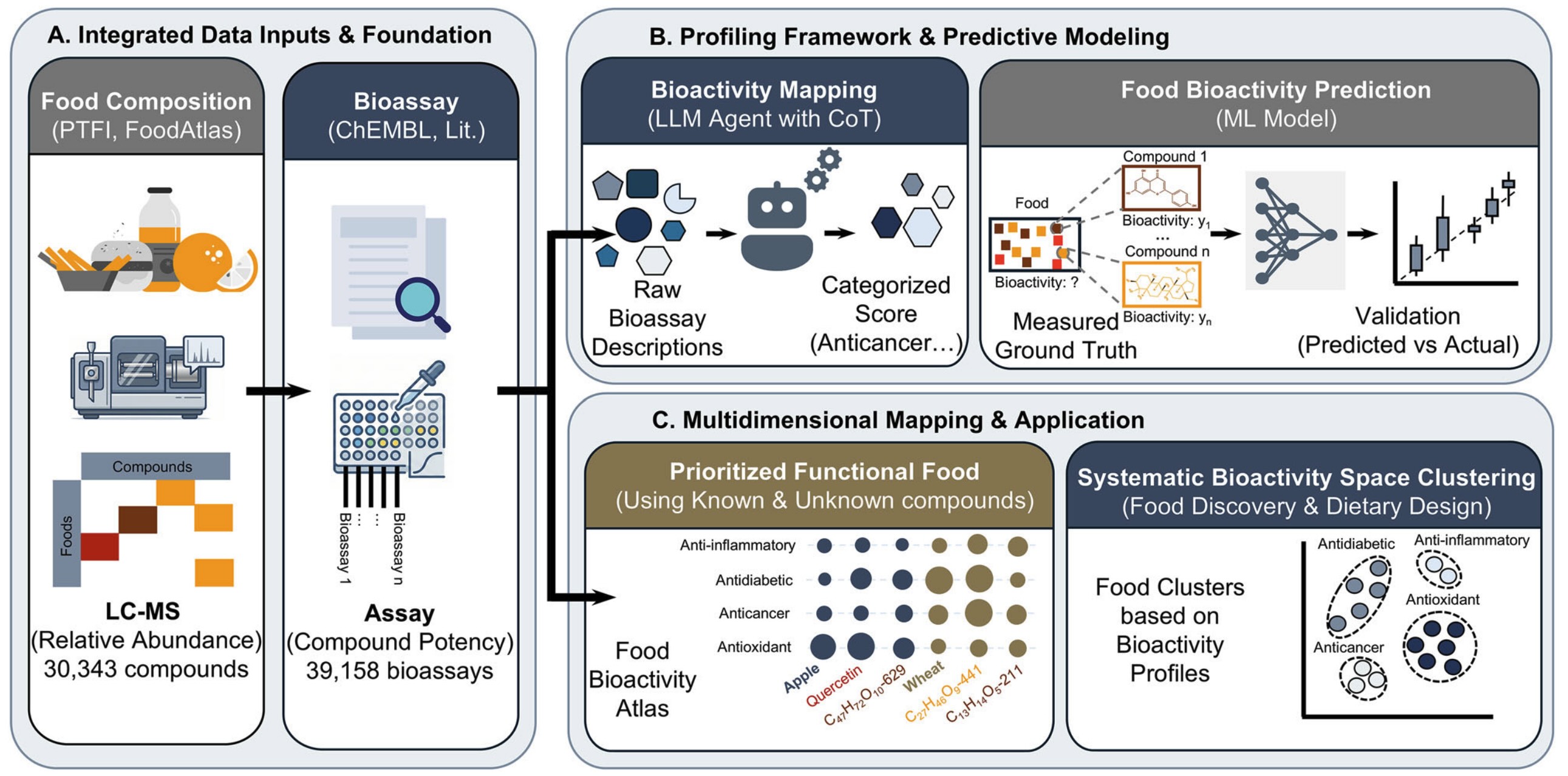
About this work: What if the thousands of unidentified molecules detected in food could be turned into testable leads for understanding food bioactivity? This work introduces a multi-layer computational framework for prioritizing potentially bioactive compounds across 322 commonly consumed foods in the United States, encompassing 30,343 small molecules. A retention-index model expanded putative structural coverage of detected metabolomic features from 7.4% to over 78% (R² = 0.95; Pearson r = 0.97) through formula-constrained matching against 11.8 million PubChem compounds. A two-stage large language model workflow further harmonized 39,158 ChEMBL assays spanning 119,633 chemical-assay measurements into standardized bioactivity classes. Using antioxidant activity as the primary whole-food endpoint, the framework achieved R² = 0.73 and Pearson r = 0.85 in predicting whole-food antioxidant measurements, while additional anti-inflammatory, anticancer, antidiabetic, antiviral, and antibacterial activities were incorporated as compound-level evidence for prioritization. Combined with SHAP-based ranking and structure-based analysis against KEAP1 using Boltz-2, the framework narrows tens of thousands of metabolomic features into confidence-ranked candidates for targeted experimental validation, providing a scalable path from food’s chemical “dark matter” to biologically interpretable hypotheses.
Reference: Gupta, Pranav, Michael Gunning, Selena Ahmed, and Ilias Tagkopoulos. “From metabolomics dark matter to bioactivity: a computational framework for prioritizing food-derived bioactive compounds.” npj Science of Food (2026). doi: 10.1038/s41538-026-01066-1